Russian American Child Modern Art Prodigy of the 80s


Child prodigies and the Art of Chess
5/20/2003 – Sergei Karjakin is the youngest grandmaster in the history of the game, and David Howell is the male child who at the age of eight vanquish a grandmaster in an official blitz game (at 11 he drew a game against Vladimir Kramnik). On June 28 the two will face up each other in an exhibition match to celebrate the opening of The Fine art of Chess exhibition. We bring you full information and some beautiful pictures.
ChessBase 16 - Mega package Edition 2022
Your key to fresh ideas, precise analyses and targeted training!
Anybody uses ChessBase, from the Globe Champion to the amateur adjacent door. Information technology is the plan of choice for anyone who loves the game and wants to know more most it. Offset your personal success story with ChessBase and enjoy the game even more.
More than...
 Eastward meets West at Somerset House
Globe's Youngest Grandmaster to play British Chess Prodigy
Sergei Karjakin, the youngest Grandmaster in chess history, volition fly to London from the Ukraine to play an Exhibition Tournament with 12 year erstwhile David Howell from Eastbourne, on Saturday 28 June 2003 to celebrate the opening of The Art of Chess at the Gilbert Collection. This exhibition match, using giant chess pieces, will accept place at 11am in the Edmond J Safra Courtyard of Somerset Business firm, Strand, London WC2. After, members of the public will be able to pit their wits against the two young stars of the chess world in a simultaneous open-air chess tournament, between noon and 5 pm. Forty tables will be in play at in one case and there volition be a prize for anyone who manages to draw or win a game against one of the young champions.
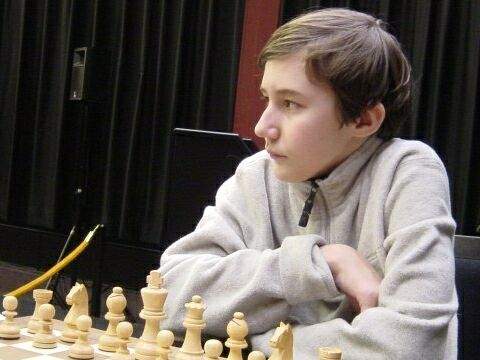
Sergei Karjakin, the youngest grandmaster in the history of chess
At present aged 13, Sergei Karjakin became the youngest ever Grandmaster when he was 12 years 7 months old at the international chess tournament held in Sudak in the Crimea final August. Sergei, an only child, was born on 12 January 1990 and grew upward in Kramatorsk, an industrial boondocks in the Ukraine. His female parent works in computers and his begetter ran a small business concern before condign a full-time coach at the local chess lodge. Sergei began learning chess from his male parent at the age of five and was chirapsia him consistently by the time he was seven. He does not get to schoolhouse regularly but plays chess every day and his outside interests are tabular array lawn tennis and films. He hopes to become earth champion at the age of 16.

David Howell, who scored a draw in a rush game against globe champion Kramnik
David Howell hit the headlines in Baronial 1999 when, anile only viii, he became the youngest actor in the globe to defeat a Grandmaster in an official game, beating Dr John Nunn in a blitz game at the Listen Sports Olympiad. He went on to become the youngest ever British thespian to defeat a Grandmaster in classical chess when he beat Colin McNab in the 2001-2 Hastings Challengers tournament. When he is not playing chess, David likewise enjoys football game, rugby, squash, table tennis and Playstation. He is a loyal Manchester United supporter and is keen on reading J. Thou. Rowling, J. R. R. Tolkien and Philip Pullman. His favourite band is the Red Hot Chili Peppers. His appetite is to get a Grandmaster and to continue playing chess internationally.
This exciting event marks the opening at the Gilbert Collection of the exhibition The Art of Chess, which features nineteen chess sets dating from the beginning of the 20th century to the present day. Each set illustrates a move in the apocryphal last game played past Napoleon with General Bertrand on St Helena in 1820. Visitors can follow the game from world'due south only known set designed by Carl Fabergé, to examples by Marcel Duchamp, a groovy chess player himself, Alexander Calder, Yoko Ono and Damien Hirst.
During the exhibition a number of other chess-related events will have place, including Man v Car on computers in the Workshop Gallery and Problem Chess, whereby a new challenge is fix up each month with prizes for the winners. Public data line, tel. 020 7420 9412.
__________________________________
For further information and photographic material, please contact:
Sue Bail Public Relations, Hollow Lane Farmhouse, Thurston, Bury St Edmunds, Suffolk IP31 RQ
Tel. +44 (0)1359 271085, Fax. +44 (0)1359 271491 E-mail. info@suebond.co.united kingdom.
The Art of Chess at the Gilbert Collection
Exhibition of Chess Sets past Major Artists from Fabergé to Hirst
One of the most compelling exhibitions in United kingdom of great britain and northern ireland this summer will be staged at the Gilbert Collection, Somerset House, London, from 28 June to 28 September 2003. The Fine art of Chess will feature xix chess sets designed past artists in the terminal hundred years that demonstrate the interaction between chess and modern art. This exhibition will illustrate how this near challenging of games has inspired artists from 1900 to the present mean solar day, every bit information technology had in earlier centuries. The exhibition is generously supported past Oleg Deripaska.
The Art of Chess will intrigue not only chess enthusiasts simply also followers of modernistic and contemporary art. Each fix in the exhibition will illustrate a movement in the apocryphal last game played by Napoleon (white) with General Bertrand (black) on St Helena in 1820. Napoleon was a dandy chess player and he allegedly won this game past exploiting the bad play of his opponent. The terminal chess set up culminates with Napoleon checkmating General Bertrand.
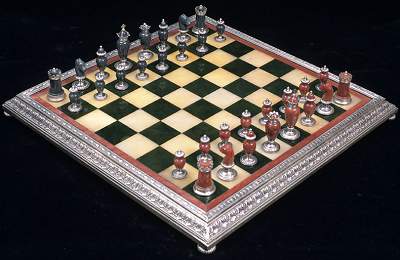
Fabergé Chess Ready. Workmaster Karl Gustav Hjalmar Armfelt, circa 1905. King 8 cm, Pawn 4.five cm, Lath 63.5 x 63.5 cm. Dr George and Vivian Dean.
The first exhibit volition exist the merely known Fabergé chess fix. Fabricated by the workmaster Karl Gustav Hjalmar Armfelt, this exquisite silverish-mounted hardstone prepare has pieces carved from tawny aventurine quartz and grey Kalagan jasper, the board being made of Siberian jade squares alternating with stake apricot serpentine. It was specially made circa 1905 for Tsar Nicolas II's Commander in Chief of the Russo-Japanese War, General Alexei Kouropatkin.

Russian Mammoth Ivory Chess Set. Kholmogory, tardily 19th century. Rex five.7 cm, Pawn 3.7cm, Douglas Polumbaum.
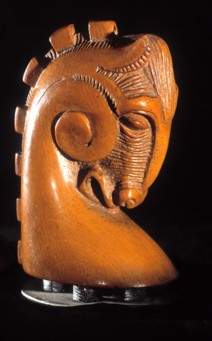
There is just 1 set dating from the 19th century: a Kholmogory Russian mammoth ivory set. The hamlet of Kholmogory, near Arkhangel'sk, was a heart of os and ivory etching, the origins of which go back to the Neolithic period. The Kings are shown as chiefs property pipes, the Bishops every bit hunters with rifles and the Knights intricately carved as reindeer heads. Such decorative sets were popular with the Russian aristocracy and this delightful example is laid out as the offset move when Napoleon brought out his Knight as did his opponent.

Propaganda Chess Set: Capitalists v Communists. Natalia and Yelena Danko, Lomonosov Land Porcelain Factory, St. petersburg, 1925. King xi.five cm, Pawn 5.ix cm
From the Soviet Union of the 1920s will exist two remarkable Russian Revolutionary chess sets that reflect the social conflicts of the time, designed by the sisters Natalia and Yelena Danko for the Lomonosov Land Porcelain Manufacturing plant in Leningrad. The rarer of the two is popularly known equally The Town and Country design and was produced in a limited number of prototypes. Ane side features the King and Queen equally mill workers, while on the opposing side the King and Queen are farm workers, the Knights water wheels and the Pawns are bottles of milk with open books beside them. In the second propaganda ready, Capitalists versus Communists, one of the Kings is modelled equally Death holding a human thigh bone.
 | Dr George and Vivian Dean Marcel Duchamp, 1919 King 10 cm, Pawn 6.2 cm Board 107 x 79 x seventy cm Individual collection |
The second gallery focuses on the work of Marcel Duchamp, the Bauhaus and Meissen. Duchamp was and then enamoured of chess that in the 1920s his professional interest in the game acquired many to conclude that he had ceased artistic activities altogether. Every bit a member of the French team, he played in the 1928 chess Olympiad.
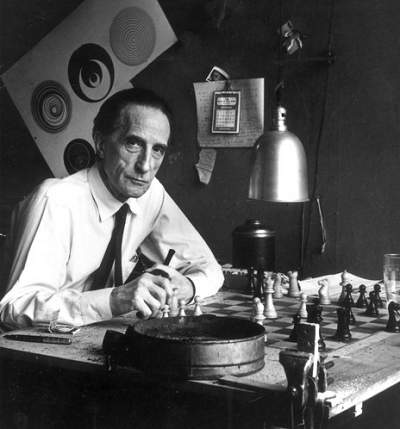
Marcel Duchamp 1950. © Jacqueline Matisse Monnier

Pocket Chess Set up with Wallet. Marcel Duchamp 1943. sixteen 10 x.5 cm. Archives Marcel Duchamp.
The exhibition features two sets by Duchamp, the outset designed while he was living in Buenos Aires in 1919. The set comes with a travelling foldaway table and a lath that has ii stopwatches for timed games. From 1943 is a pocket ready with a leather wallet, celluloid pieces and ingenious pin attachments, designed by Duchamp as a 'Rectified Readymade'.
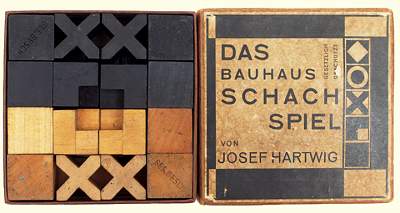
Bauhaus Chess Set. Josef Hartwig, 1924. Rex 4.seven cm, Pawn 2 cm. Douglas Polumbaum.
One of the almost important influences on the design of chess sets in the 20th century was the Bauhaus school of fine art and blueprint which flourished in Germany between 1919 and 1928. Josef Hartwig was the Workshop Main in charge of woodcarving and the assault view demonstrates in miniature the Bauhaus design principles. He rejected the traditional thought of figures and based his design on the function of the pieces on the lath. The King, for example, is a cube diagonally assail top of a larger cube reflecting the mode that the piece can move in a limited mode in all directions while the Queen, the most mobile piece in the game, is a sphere on pinnacle of a big cube, the fluid sphere representing the privileged degree of movement the piece is allowed.

Stoneware Chess Gear up. Max Esser, Meissen, circa 1920. King nine cm, Pawn iii.2 cm. Douglas Polumbaum.
A Meissen stoneware Art Deco 'futuristic' chess set was designed by Max Esser, a primary craftsman for the celebrated porcelain mill in the 1920s. The terracotta and dark chocolate brownish pieces are in the fashionable Art Deco fashion: the Bishops in the form of Japanese tsunami, or giant crested waves, and the Knights equally stylised horses' heads.
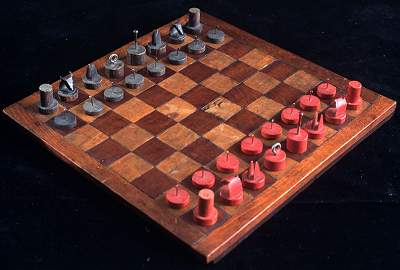
Travelling Chess Set. Alexander Calder, 1942. King 6.4 cm, Pawn two.9 cm. Private drove.
The tertiary gallery is devoted to the chess sets of the Advanced and Fluxus movements. A travelling chess set, designed by the American sculptor Alexander Calder, illustrates the creative person's ability to manner intensely evocative art from the droppings of daily life. Completed over a weekend in 1942, it is made from segments of a broom handle which he then daubed with ruddy and black paint. The resulting pieces are a combination of abstract and figurative design.
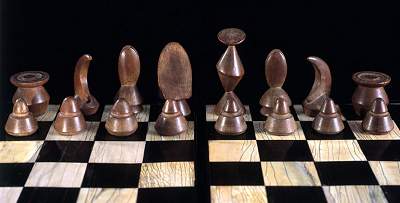
Boxwood Chess Gear up made for The Imagery of Chess exhibition at the Julien Levy Gallery. Max Ernst, 1944. King 10.v cm, Pawn 4.5 cm. Private drove.
In 1944 the Julien Levy Gallery in New York commissioned a number of gimmicky artists to design chess sets for an innovative exhibition entitled The Imagery of Chess. Amidst the original exhibits was a boxwood set by Max Ernst. The abstruse pieces possess a rhythm that plays out across the board during a game. The powerful curve of the crescent-shaped Knight suggest both a horse's head and the circuitous character of the moves while the configuration of the Bishop evokes both a mitre as well as its ability to move two ways.
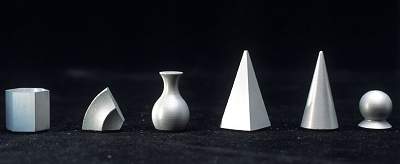
Chess Fix. Human Ray, 1946. King v.5 cm, Pawn 2.v cm. Board 44.5 x 44.v cm. Collection A & R Penrose.
Human Ray'south abstract set of 1946 has pieces of ruddy and silver anodised alloy with a varnished wood board. Homo Ray was an avid amateur chess player although his friend Marcel Duchamp jokingly referred to him equally piddling more than than 'a forest pusher'. Nonetheless Human being Ray said that his interest in the game was "directed towards designing new forms for chess pieces, of not much interest to players, simply to me a fertile field for invention".
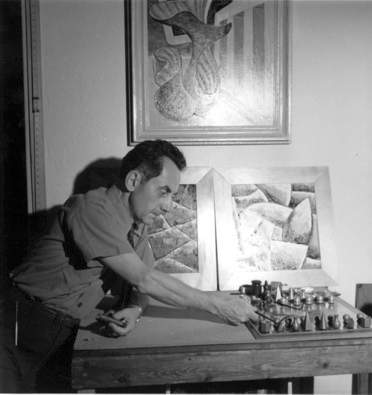
Human being Ray playing chess at home in Hollywood, 1946. © Lee Miller Archives.
Yoko Ono, also an avid chess player, was a member of the informal international group of artists from the early on 1960s to the late 1970s known as Fluxus. Her painted forest set up White on White Chess Gear up from 1966 was surprisingly classical in design and comes with white chairs, a white inlaid board and white pieces. In this exhibition, the 1997 version of the original entitled Play it by Trust is on testify. The concept of an all-white chess set derails any ordinary game as the players lose rails of their pieces, ideally leading to a shared understanding of common concerns. Takako Saito's Fluxus Weight Chess Set from 1964 was made to fit into a drawer of a 'Flux Cabinet' and comprises a series of identical white boxes - each piece being defined by its weight. The Male monarch, for instance, has steel ball bearings in the box while the boxes for the Pawns comprise sand. George Maciunas, another leading Fluxist artist, is represented by Colour Balls in Bottle-Board-Chess Set of 1966 which is made from glass jam jars glued together to form a square lath with coloured balls within them. To brand a move it is necessary to reach inside the relevant jar and move the ball to another jar on the 'board'.
The final gallery is devoted to the five contemporary sets and boards commissioned in 2001 past RS&A Ltd, a new London-based company dedicated to producing innovative projects with contemporary artists. Each set, fabricated in an edition of seven, is individually crafted in a diverseness of different materials such as wood, porcelain, glass and argent and packaged to the artist's specified wishes. Damien Hirst's Mental Escapology gear up comprises drinking glass and silver casts of medicine bottles with etched silver labels. The glass and mirrored lath displays the biohazard symbol. It is accompanied by its own glass medicine breast.
The set designed by Jake and Dinos Chapman has hand-painted black and white statuary figures and a wood marquetry board inlaid with black and white double-headed skulls and crossbones. The pieces are mail-apocalyptic adolescent figures, ane side white with Arian haircuts, the opposing side black with Afro hair. The set is packaged in its own handcrafted games box. The Los Angeles artist Paul McCarthy is a keen chess histrion. His Kitchen Chess set up is made from random objects institute in his own kitchen such equally a miniature rubber duck and a ketchup canteen. The board and box have been made from the artist'south kitchen floor that was ripped up during the project as a tribute to Duchamp's chess lath design of 1937.
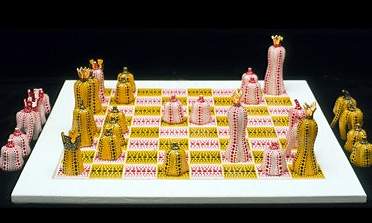
Pumpkin Chess. Yayoi Kusama, 2003. King fourteen.v cm, Pawn 6.5 cm. Presented in a leather Pumpkin display example.
Japanese artist Yayoi Kusama's porcelain Pumpkin Chess set and board is busy with her signature spot motif. Made past the German porcelain factory Villeroy & Boch, the white side has cherry-red dots while the opposing side bears black dots on a yellow ground. The porcelain lath is painted with the same color combination. The gear up is presented in a white leather brandish case. The final exhibit, laid out as Napoleon'southward fictional last move, is the cosmos of Italian artist Maurizio Cattelan who is known for his mischievous sense of humour. Made past Bertozzi and Casoni and titled Good versus Evil, the blackness King is shown as Hitler opposed on the white side past Martin Luther Rex. Notable figures such as Donatella Versace, Rasputin, General Custer, Superman, Mother Teresa and Sitting Bull appear as Pawns.
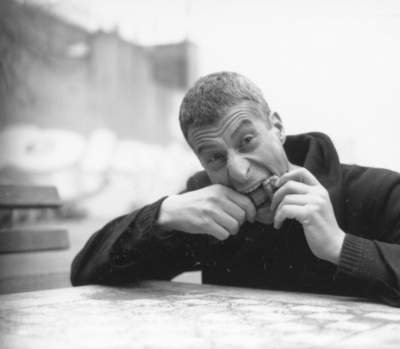
Maurizio Cattelan photographed in New York in 2003 with his blackness Male monarch alias Adolf Hitler; role of his Good versus Evil chess set design.
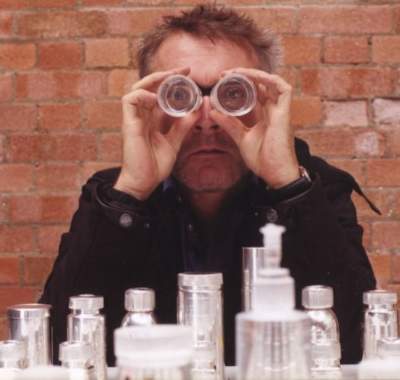
Damien Hirst photographed in London in 2003, with two glass rooks over his eyes in forepart of his 2003 set Mental Escapology.
The exhibition ends with two classic silent films, Chess Fever and Entr'acte. The onetime is an early Soviet one-act featuring a number of the globe'due south greatest chess players, filmed during a tournament in Moscow in 1925. Vladimir Fogel, a leading comic actor of the 1920s, plays a hapless chess fanatic. Entr'acte was fabricated in Paris in 1924 to be shown between two acts of Francis Picabia's ballet Relâche.
The origin of chess is unclear. It is believed to accept originated around the 7th century in Republic of india or Persia and derived from an before Indian game. Later reaching Arab countries information technology had spread all over western Europe by the 10th century. No other game in history has been and then widely reflected in art and literature around the world. The Fine art of Chess volition show that in the 20th and 21st centuries chess has lost none of its inspirational power.
'From my shut contact with artists and chess players I have come to the personal conclusion that while all artists are non chess players, all chess players are artists.' Marcel Duchamp, Cazenovia, 1952
__________________________________
For further information and photographic fabric, delight contact:
Sue Bond Public Relations, Hollow Lane Farmhouse, Thurston, Bury St Edmunds, Suffolk IP31 RQ
Tel. +44 (0)1359 271085, Fax. +44 (0)1359 271491 Email. info@suebond.co.uk.

Source: https://en.chessbase.com/post/child-prodigies-and-the-i-art-of-che-i
0 Response to "Russian American Child Modern Art Prodigy of the 80s"
Post a Comment